skip to main |
skip to sidebar
 (1) Capillary Voltage: -3.0 kv.(2) Cone Voltage: -40 v.(3) Collision Energy: 18 ev.(4) MRM: m/z 299.5 →m/z 255.2.

 Happy Spring Festivals 2009!
(1) Compounds That Cause Sensitivity Suppression.
-Salts can interfere with ionization and can cluster to complicate spectrum (but also aid in identification).
-Strong bases or quaternary amines can interfere with positive mode analytes, e.g. Triethylamine(TFA).
-Acid -Sulfuric/Sulfonicacids and TFA interfere in negative mode.
-Phosphate buffer and non-volatile ion pairing agents (e.g. SDS) can cause severe suppression and complex spectrum.
(2) Dimerization([2M+H]+) can occur at high concentration, leading to non-linearity during quantitation.
-DimerSignal at m/z = (MW*2) + 1.
-Can cause non-linearity at high concentrations.
The current global shortage of Acetonitrile has pushed us to find 5 ways to reduce thedependence on AcetonitrileOption 1: Reduce column ID:
Reducing the HPLC column ID from 4.6 mm to 3.0 mm can result in > 50 % reduction in mobile phase consumption. Option 2: Reduce particle size and column dimensions: * Reduces solvent consumption * Maintains resolution * Reduces run timeOption 3: Reduce column length:Option 4: Substitute Acetonitrile with Methanol:http://www.phenomenex.com/images/methanal_replacement.gifOption 5: Solvent recycling (Isocratic separations only)Reference by Phenomenex.

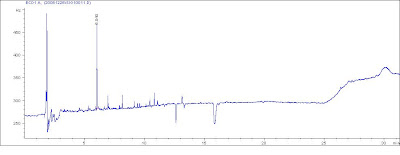 Agilent 6890N ECD.Temp Ramp: 80℃(1min)----20℃/min--- 260℃(15min)----5℃/min---300℃(3min),Detector Temp: 300℃Inlet: 250℃GC Column:HP-5.
 (1) Maybe the collision energy is too LOW. The First MS is not full a fragment.(2) Are you using ESI mode?(3) If the Molecular weight is 237, for SIM -> Here are three characteristic ions (m/z) 164,149,122 I highly recommend them.(4) MS-MS (MRM): Need to search online for the product ion and parent ions.(5) If only need the full scan, why not adjust the concentration of analyte.Hope it helps.
 Go to MassHunter, File->TIC->.....
 (1) Try to adjust the the capillary voltage: increase it a little bit each time.If the the mass response of [M+H2O -H]- is decrease, the mass response of [M-H]- increase: then the m/z (563.10761) definitely is the molecular Ion.If No such change happened, then the m/z (563.10761) definitely is NOT the Molecular Ion.(2) From my view, the possibility of [M+H2O-H]( belongs to Molecular ion) is very low. Under ESI (-) negative mode, the trend of forming
the [M+HCOOmore high.Doubt the H2O have that much acidity for forming the ion peak.
 (1) Capillary Voltage: -3.0 kv.

 Agilent 6890N ECD.
 (1) Maybe the collision energy is too LOW. The First MS is not full a fragment.


